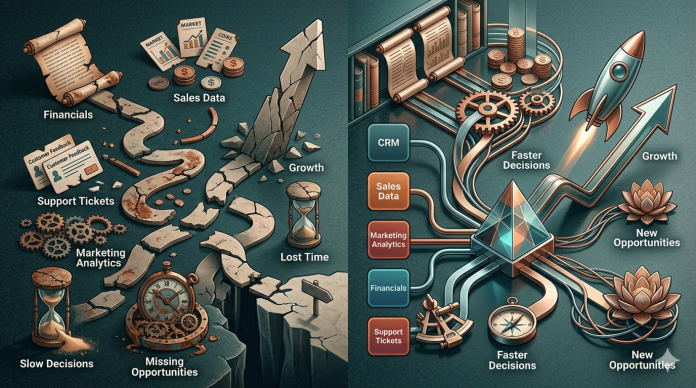
Most growing businesses today have more data than they’ve ever had. Ad performance from Google, Meta, TikTok, LinkedIn, and Snapchat. Revenue from Shopify and Stripe. Email metrics from Klaviyo or Mailchimp. CRM data from HubSpot. Web analytics from Google Analytics. Financial data from QuickBooks.
The problem isn’t the volume. The problem is that it’s all sitting in separate platforms, in separate dashboards, in separate logins, and nobody has a complete picture of what’s actually going on.
That’s fragmented data. And for small and mid-sized businesses, it’s one of the most damaging and least talked about growth problems there is.
What Fragmented Data Actually Means
Fragmented data is what happens when your business information is spread across multiple disconnected platforms with no central place to view, compare, or analyze it together.
When your ad spend lives in one place and your revenue lives in another, you can’t easily see whether your campaigns are actually driving growth. When your email performance is disconnected from your sales data, you can’t measure the real impact of your marketing. When your financial data is separate from everything else, you’re always working with an incomplete picture.
The Real Cost of Fragmented Data
The consequences of fragmented data aren’t always obvious because they don’t show up as a single line item. They show up as friction, slow decisions, missed opportunities, and wasted spend. Here’s where the cost actually hides:
Hours Lost to Manual Reporting
Someone on your team is spending time every week pulling data from multiple platforms and assembling it into a spreadsheet or a slide deck. That time adds up fast. For most growing businesses, manual reporting consumes anywhere from 3 to 8 hours per week across the team. That’s time that could go toward strategy, optimization, and execution.
Decisions Made on Incomplete Information
When you can only see part of the picture, you make decisions based on partial information. You might double down on a channel that looks strong in isolation but is actually cannibalizing another. You might cut spend on a campaign that looks underperforming when it’s actually driving downstream conversions you can’t see. Fragmented data doesn’t just slow decisions. It makes them less accurate.
Slow Reaction to Problems
When your data is scattered, problems don’t get caught early. A drop in conversion rate, an ad account that’s burning budget, a sudden change in customer acquisition cost — these things should trigger immediate action. But if you’re only reviewing each platform separately and infrequently, you find out about problems after they’ve already cost you.
Missed Connections Between Channels
Growth rarely happens in a single channel. It happens in the interaction between them. A customer sees your TikTok ad, Googles your brand, clicks a search ad, opens a Klaviyo email, and converts on Shopify. If your data is fragmented, you never see that full journey. You optimize each channel in isolation and miss the compounding effect of how they work together.
Strategy Built on Gut Feel
When pulling real data is painful, people stop doing it as often. Strategy meetings happen without current numbers. Decisions get made based on what feels right rather than what the data shows. This is how businesses end up scaling things that don’t work and underinvesting in things that do.
Why This Problem Gets Worse as You Grow
Fragmented data is manageable when you’re running one or two channels. It becomes a serious liability when you’re running five or ten.
Early stage, you might have Shopify and one ad platform. You can keep up with it manually. But as you add channels, add team members, and add complexity, the number of data sources multiplies. The time required to consolidate them manually grows. The chances of something slipping through the cracks increase. And the cost of slow or wrong decisions gets higher because the stakes are higher.
What Fixing It Actually Looks Like
Solving fragmented data doesn’t require a data engineering team or an enterprise software budget. It requires a centralized platform that connects your tools and brings your data together automatically.
The goal is simple: one place where all your business data lives, updates on its own, and can be viewed, compared, and analyzed together.
When that’s in place, a few things change immediately:
Reporting becomes automatic. Instead of pulling data manually, your platform assembles it for you. Reports that used to take hours take seconds.
Performance becomes visible across channels. You can see how your Google Ads spend connects to your Shopify revenue. How your Klaviyo campaigns affect your Stripe recurring revenue. How your organic traffic from Google Search Console compares to your paid traffic performance.
Problems surface faster. When all your data is in one place and updated daily, anomalies are immediately visible. You catch the drop before it becomes a crisis.
Strategy gets grounded in reality. When data is easy to access, it actually gets used. Planning conversations happen with current numbers on the table. Decisions are made with more confidence because they’re backed by the full picture.
The AI Layer That Changes Everything
Centralizing data solves the fragmentation problem. But there’s a step beyond that: using AI to interpret the data once it’s together.
Most businesses, even after centralizing their data, still need someone to make sense of it. To look at a week’s worth of numbers and understand what they mean. To identify what changed, why it changed, and what to do about it.
AI-powered BI platforms handle that interpretation automatically. Instead of a dashboard that shows you what happened, you get a platform that tells you what happened, what it means, and what you should be thinking about next. That’s the difference between data that sits there and data that drives decisions.
How NeuraBoard Solves Fragmented Data
NeuraBoard connects to 13 of the most widely used business platforms including Google Ads, Meta Ads, TikTok Ads, LinkedIn Ads, Snapchat Ads, Shopify, Stripe, QuickBooks, HubSpot, Klaviyo, Mailchimp, Google Analytics, and Google Search Console.
Once connected, your data updates automatically every day. No manual exports. No spreadsheet assembly. No toggling between dashboards.
On top of centralized data, NeuraBoard’s AI generates performance reports, tracks your KPIs against targets, answers questions about your data through a built-in AI Assistant, and helps you model strategies and growth scenarios before you commit to them.
The Bottom Line
Fragmented data is a growth tax. It costs your team time, slows your decisions, hides your problems, and prevents you from seeing how your business actually works as a whole.
The businesses that grow fastest aren’t the ones with the most data. They’re the ones who can see and act on their data faster than everyone else.
Centralizing your data is the first step. Using AI to interpret it is what gives you the edge.
Start your free 14-day trial of NeuraBoard and see what your business looks like when everything is finally in one place.